

+919824099945

Currently it only shows your basic business info. Start adding relevant business details such as description, images and products or services to gain your customers attention by using Boost 360 android app / iOS App / web portal.

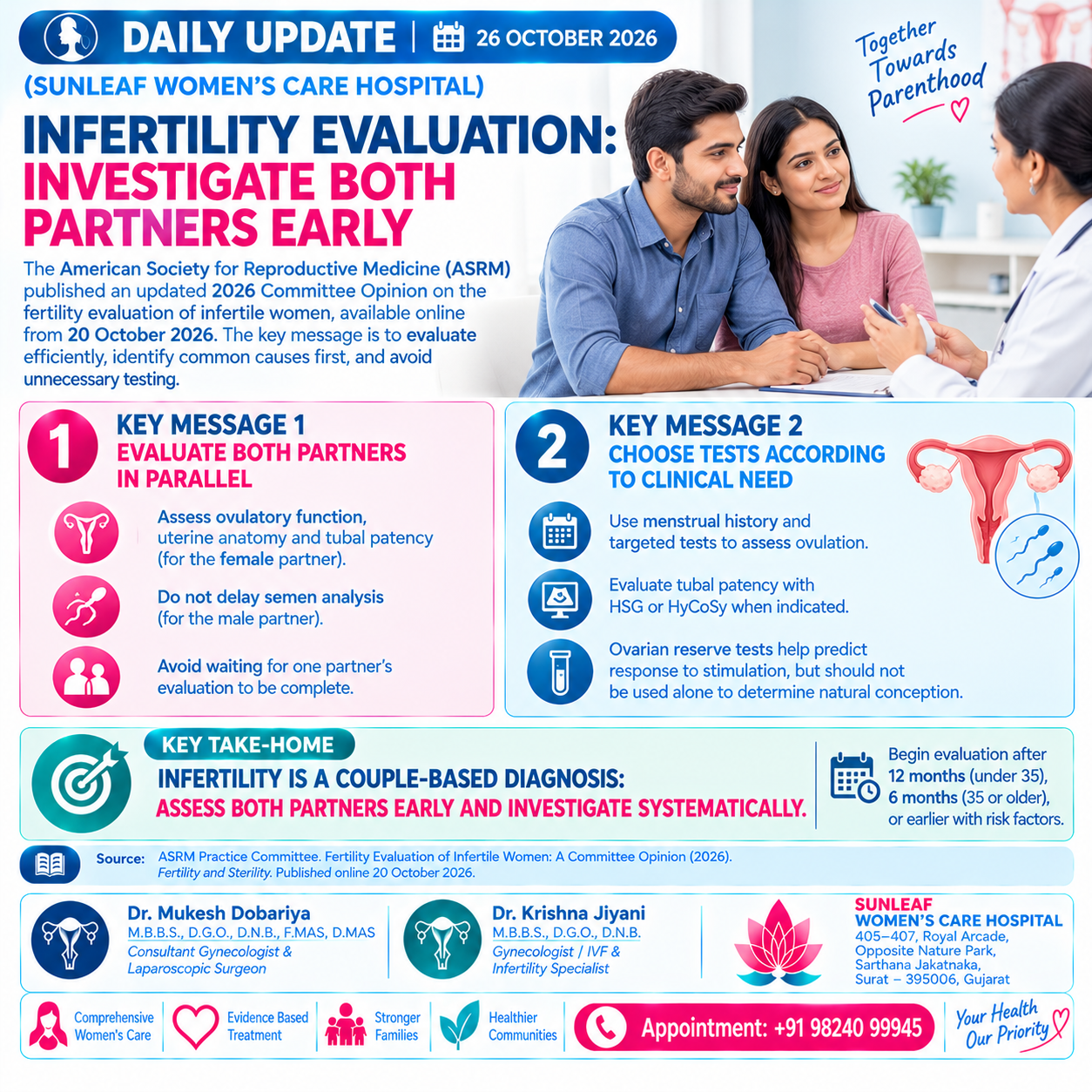
The American Society for Reproductive Medicine (ASRM) published an updated 2026 Committee Opinion on the fertility evaluation of infertile women, available online from 20 October 2026. The key message is to evaluate efficiently, identify common causes first, and avoid unnecessary testing. Two high-impact clinical messages - Evaluate both partners in parallel. Assess ovulatory function, uterine anatomy and tubal patency, alongside semen analysis. Do not delay male-factor assessment until the female evaluation is complete. - Choose tests according to clinical need. Use menstrual history and targeted investigations to assess ovulation; evaluate tubal patency with HSG or HyCoSy when indicated. Ovarian reserve tests help predict response to ovarian stimulation, but should not be used alone to determine whether a woman can conceive naturally. ScienceDirect Key take-home message Infertility is a couple-based diagnosis: assess both partners early and investigate systematically. Begin evaluation after 12 months of trying when the woman is under 35, after 6 months at age 35 or older, and earlier when there are risk factors such as irregular or absent periods, suspected tubal disease, endometriosis or known male-factor concerns. Source ASRM Practice Committee. Fertility Evaluation of Infertile Women: A Committee Opinion (2026). Fertility and Sterility. Published online 20 October 2026. Read the updated committee opinion Hashtags #SunleafHospital #SunleafWomensCare #InfertilityEvaluation #FertilityCare #MaleFactorInfertility #Ovulation #TubalPatency #IVF #ReproductiveMedicine #EvidenceBasedMedicine #Surat #Varachha #NanaVarachha #MotaVarachha #Sarthana #Pasodara #Godadara #Dindoli #Vesu #Velanja #Kamrej #Amroli #Kosamba #Ankleshwar #DrMukeshDobariya #DrKrishnaJiyani


