
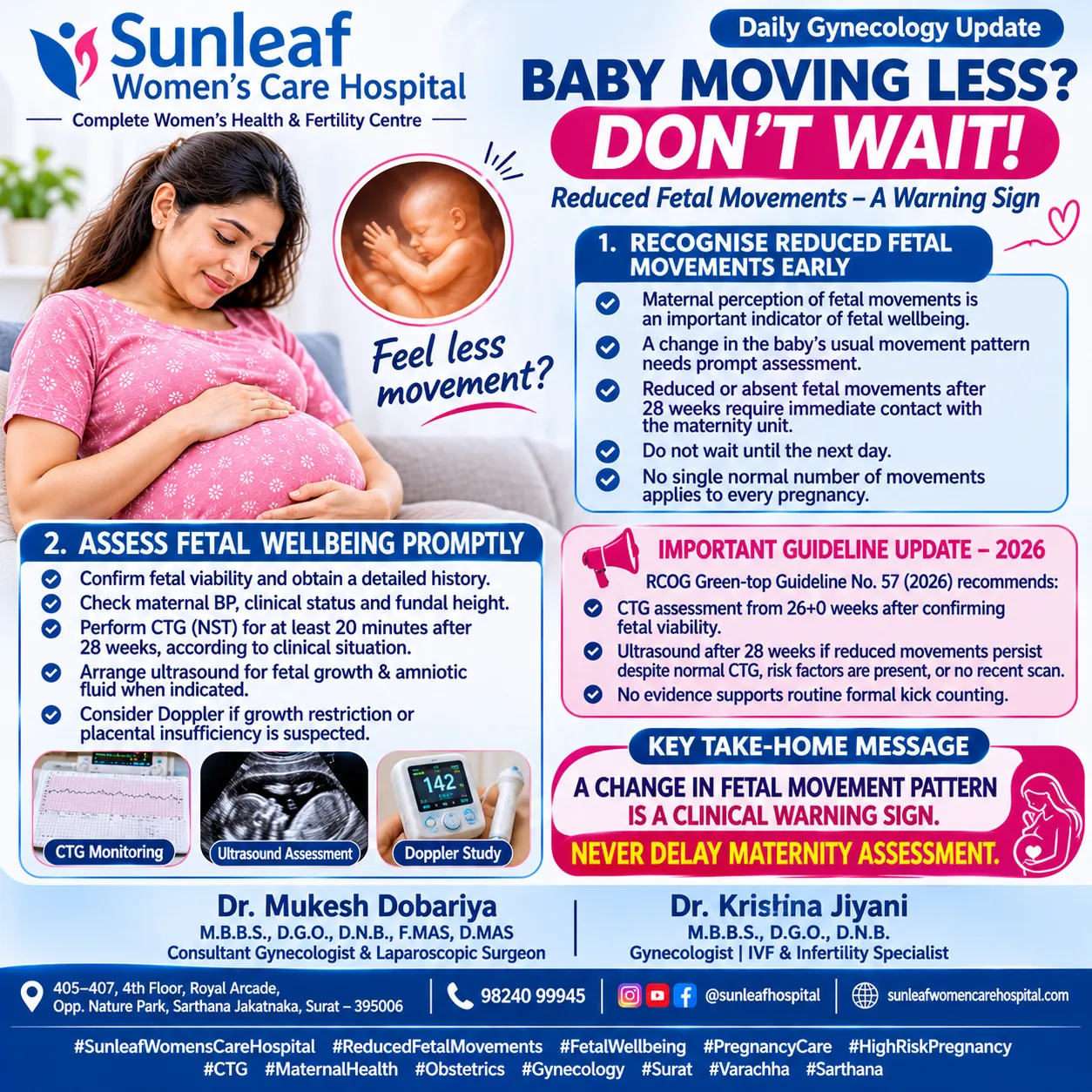
REDUCED FETAL MOVEMENTS – NEVER IGNORE THE SIGNAL
SUNLEAF WOMEN'S CARE HOSPITAL
2 KEY EVIDENCE-BASED MESSAGES
1. RECOGNISE REDUCED FETAL MOVEMENTS EARLY
- Maternal perception of fetal movements is an important indicator of fetal wellbeing.
- A change in the baby's usual movement pattern needs prompt assessment.
- Reduced or absent fetal movements after 28 weeks require immediate contact with the maternity unit.
- Do not advise the mother to wait until the next day.
- There is no single normal number of movements that applies to every pregnancy.
2. ASSESS FETAL WELLBEING PROMPTLY
- Confirm fetal viability and obtain a detailed history.
- Check maternal BP, clinical status and fundal height.
- Perform CTG (NST) for at least 20 minutes after 28 weeks, according to the clinical situation and local protocol.
- Arrange ultrasound assessment of fetal growth and amniotic fluid when clinically indicated.
- Consider Doppler assessment when fetal growth restriction or placental insufficiency is suspected.
IMPORTANT GUIDELINE UPDATE – 2026
The updated RCOG Green-top Guideline No. 57 (2026) recommends:
- CTG assessment from 26+0 weeks after confirming fetal viability.
- Ultrasound after 28 weeks when reduced movements persist despite normal CTG, risk factors are present, or no recent ultrasound is available.
- No evidence supports routine formal kick counting using a fixed number of movements.
RCOG+2
KEY TAKE-HOME MESSAGE
A CHANGE IN FETAL MOVEMENT PATTERN IS A CLINICAL WARNING SIGN. NEVER DELAY MATERNITY ASSESSMENT.
#SunleafWomensCareHospital #ReducedFetalMovements #FetalWellbeing #PregnancyCare #HighRiskPregnancy #CTG #FetalMonitoring #MaternalHealth #Obstetrics #Surat #Varachha #Sarthana
Keywords