PPH: Early Recognition, Immediate Action, Better Maternal Outcomes
2 KEY EVIDENCE-BASED MESSAGES
1. Recognise and treat PPH early
- Do not wait for profound hypotension or shock.
- Quantify blood loss rather than relying only on visual estimation.
- Activate the PPH protocol promptly.
- Assess uterine tone, genital tract trauma, retained tissue and coagulation abnormalities (4 Ts).
2. The first-response treatment bundle saves lives
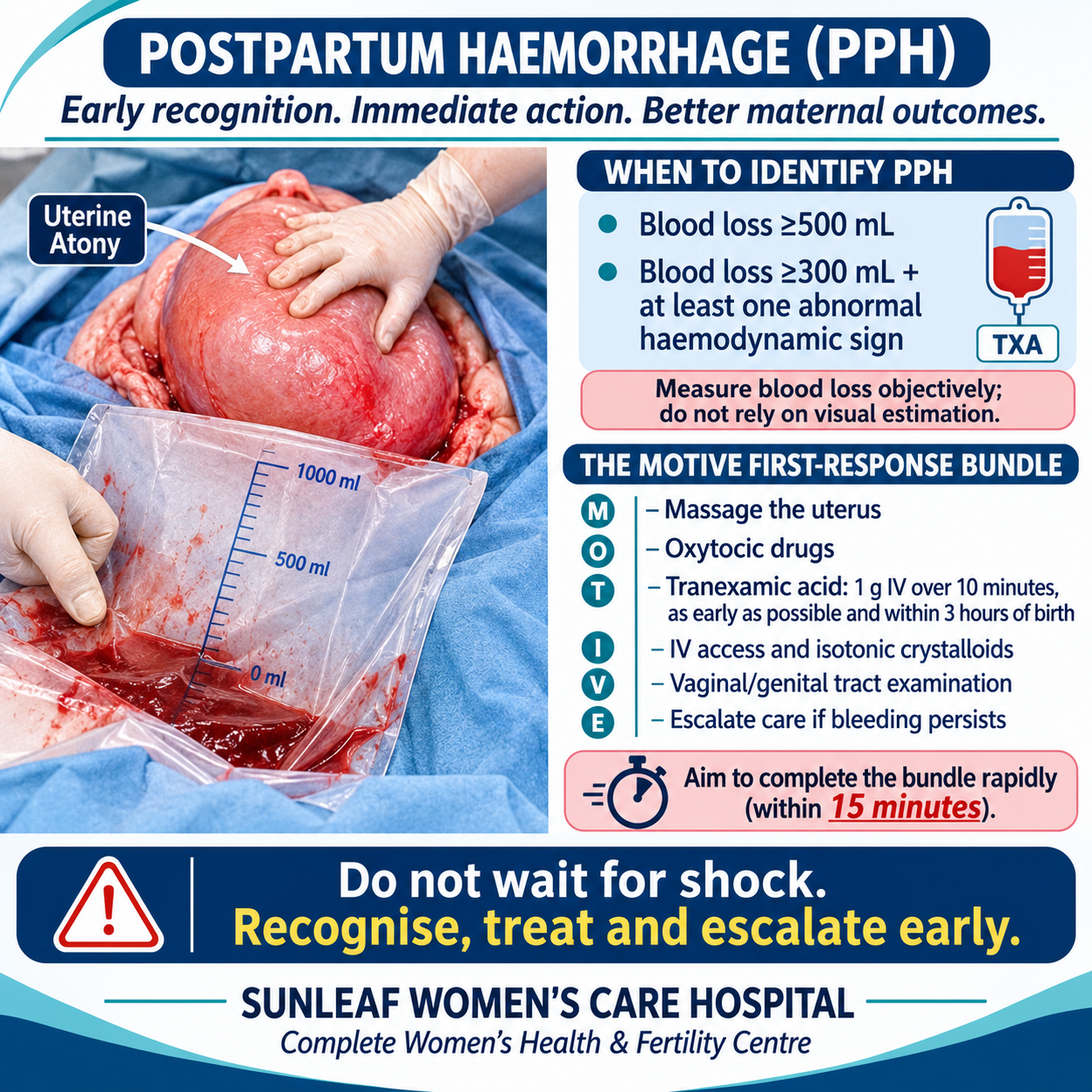
The WHO-recommended first-response bundle includes:
- Uterine massage – assess and treat uterine atony.
- Oxytocic drugs – administer appropriate uterotonics.
- Tranexamic acid (TXA) – 1 g IV over 10 minutes, as early as possible and within 3 hours of birth.
- IV fluids – initiate isotonic crystalloids.
- Examination – identify the bleeding source.
- Escalation – call for senior, anaesthesia and blood bank support.
2026 PRACTICE UPDATE – IMPORTANT CHANGE
WHO UPDATED GUIDANCE – JULY 2026
The updated WHO diagnostic criteria recommend initiating treatment when:
- Blood loss is ≥500 mL, OR
- Blood loss is ≥300 mL with at least one abnormal haemodynamic sign.
Warning signs include tachycardia, hypotension and clinical evidence of ongoing significant bleeding. Objective blood-loss measurement is preferred over visual estimation.
KEY TAKE-HOME MESSAGE
Do not wait for 500 mL blood loss if the patient already has 300 mL blood loss with abnormal vital signs. Early recognition and the MOTIVE bundle can prevent progression to severe haemorrhage.
#SUNLEAFWOMENSCARE #PPH #POSTPARTUMHAEMORRHAGE #MATERNALHEALTH #OBGYN #OBSTETRICEMERGENCY #SURAT #VARACHHA #SARTHANA
Keywords