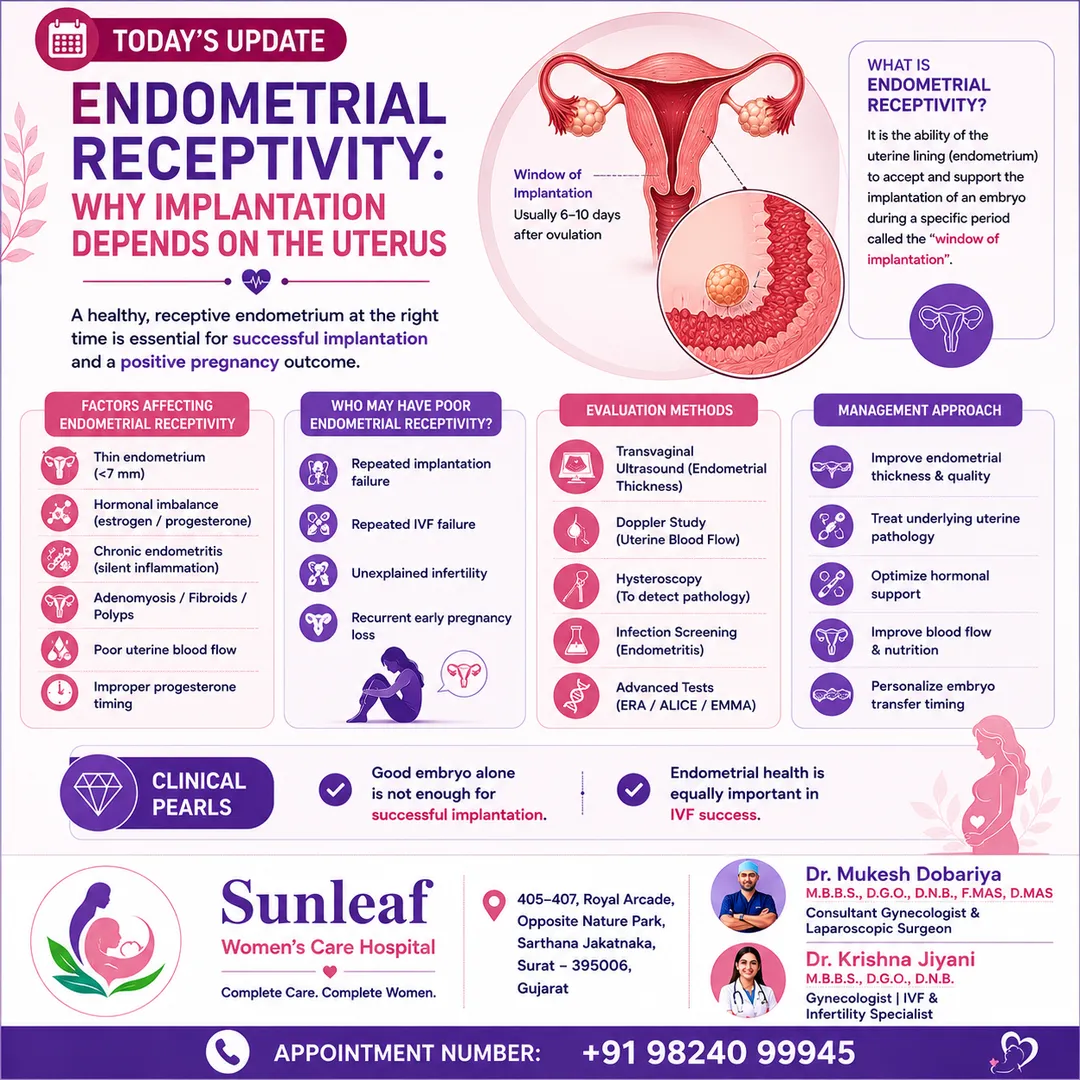
Endometrial receptivity refers to the ability of the uterine lining to allow successful embryo implantation during a specific time known as the “window of implantation.” Even a good-quality embryo may fail if the endometrium is not properly prepared.
Hormonal balance, especially estrogen and progesterone, plays a major role in preparing the endometrium. Factors such as thin endometrium, chronic endometritis, adenomyosis, altered blood flow, or improper progesterone timing can negatively affect receptivity and reduce pregnancy chances.
Women with poor endometrial receptivity may present with recurrent implantation failure, repeated IVF failure, or unexplained infertility. Ultrasound assessment, hysteroscopy, Doppler studies, and selected advanced tests help evaluate uterine readiness for implantation.
Management focuses on improving endometrial health, correcting uterine pathology, optimizing hormonal support, and individualizing embryo transfer timing. Proper synchronization between embryo and endometrium is essential for successful pregnancy outcomes.
Clinical Pearls:
- Good embryo alone is not enough for successful implantation
- Endometrial health is equally important in IVF success
#ENDOMETRIALRECEPTIVITY #IMPLANTATION #IVF #IVFSURAT #FERTILITYTREATMENT #INFERTILITYSPECIALIST #EMBRYOTRANSFER #IVFFAILURE #INFERTILITY #GYNECOLOGY #OBSTETRICS #HYSTEROSCOPY #FERTILITYCARE #INFERTILITYCARE #IVFJOURNEY #UTERINEHEALTH #ENDOMETRIUM #WOMENSHEALTH #SUNLEAFHOSPITAL #SUNLEAFWOMENSCARE #SURATDOCTOR #VARACHHA #MOTAVARACHHA #NANAVARACHHA #VALENJA #KAMREJ #VALAK #PANDESARA #PUNAGAM #DINDOLI #PREGNANCYCARE #REPRODUCTIVEHEALTH
Keywords